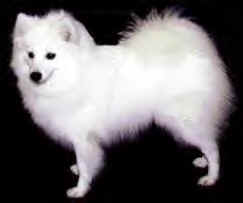
A Brief HistoryIt seems that many thousands of years ago some "Spitz Type Dogs" from central Europe made their way across Eastern Europe and Asia to Japan, arriving there about the year 500 A.D. The Japanese people found these dogs to be very suitable as "Companion Dogs" for their large extended families and small gardens. In 1954 the Japanese Kennel Club drew up an official breed standard. It is an adaptation of this standard that is used today. Breed CharacteristicsThey are a small to medium dog with a white "off-standing" coat and expressive dark eyes. They are nearly always smiling, and since their head reaches a little below knee height, they are a good family-sized dog. "Adaptable" is the word that best describes them. They thrive anywhere from cool coastal climate of San Francisco, the searing heat of Central Australia to the snowy North of Scandinavia. They live happily inside or outside in most climates. If you want them to run in the park with you they will gladly do so. However, they like a cuddle and being loving and companionable, are more than happy to sit with you while you watch T.V. or do the gardening. Their fairly light build ensures that they are not likely to knock over frail people, or young children. They are athletic and robust and will jog along with the fitness conscious members of the family. They enjoy the company of other dogs and cats, but playing with children is their favorite pastime. Their coat looks as if it needs a lot of attention. This is not the case. The "Teflon" texture of the outer coat allows mud and dirt to drop off as soon as it dries. One or two baths a year is quite sufficient as this breed has no "doggy odour". Clipping or plucking is not necessary and a 10 minute comb twice a week will keep them immaculate. People who are allergic to dog hair usually have no trouble with this breed. These dogs are not fussy eaters, are cheap to feed and don't have skin complaints. Japanese Spitz are easy to train but, of course, as with any dog, you must spend some time with them showing them what it is that you want them to learn. This is especially important in the first few months of their lives. They are a healthy dog and apart from vaccinations, visits to the vet should be very few, if any. In short, the Japanese Spitz is a Breed Apart! |
|
Standards - JAPANESE SPITZ: Height: 12 - 14" (30.5 - 35.6cm Weight: 11 - 13 lbs (4.9 - 5.8 kg) Bitches slightly smaller
Kennel Club, London 1994
GENERAL APPEARANCE - Profuse, pure white, stand-off coat. Pointed muzzle, triangular shaped ears standing erect. Bushy tail curled over back. Overall quality of body firm and strong, full of flexibility. Ratio of height to length, 10:11. CHARACTERISTICS - Affectionate, companionable. Slightly chary at first meeting with strangers. The Japanese Spitz is a bold and intelligent little dog that has courage beyond its size, and makes a wonderful companion. A lively dog, will bark to warn you when strangers approach. TEMPERAMENT - Alert, intelligent, bold and lively. HEAD AND SKULL - Head medium size, without coarseness; moderately broad, slightly rounded. Skull broadest at occiput; well defined stop; forehead not protruding. Muzzle pointed, neither too thick nor too long. Lips firm, tightly closed, black. Nose round, small and black. EYES - Dark, moderate size, oval shaped, set rather obliquely and not too wide apart; black eye rims. EARS - Small, triangular, standing erect. Set high, facing forward, not too wide apart. MOUTH - Jaws strong with perfect, regular and complete scissor bite, i.e. the upper teeth closely overlapping the lower teeth and set square to the jaws. NECK - Strong, arched and of moderate length. FOREQUARTERS - Well proportioned and balanced. Shoulders well laid. Forelegs straight; elbows firm and tight; pasterns slightly sloping. BODY - Chest broad and deep. Ribs powerfully sprung; belly moderately firm with good tuck-up. Back straight and short. Loins broad and firm. Croup slightly arched. HINDQUARTERS - Well proportioned and balanced. Muscular, moderately angulated. Hind legs parallel to each other viewed from rear. FEET - Small round, cat-like and well cushioned. Pads black, nails preferably dark. TAIL - Moderate length, root set high, curled over back. GAIT/MOVEMENT - Light, nimble, active, energetic and very smooth. COAT - Outer coat straight and stand-off. Profuse, short, dense undercoat, soft in texture. Shorter on face, ears, front of fore and hind legs and below hocks. Remainder of body covered with long coat. Mane on neck and shoulders reaching down to brisket. Tail profusely covered with long hair. The double coat is very long, thick, and profuse, and always white. The coat sheds off dirt easily. COLOR - Pure white. SIZE - Height: Dogs 30-36 cms (12-14 ins) at shoulders; Weight: 11 - 13 lbs (4.9 - 5.8 kg) Bitches slightly smaller FAULTS - Any departure from the foregoing points should be considered a fault and the seriousness with which the fault should be regarded should be in exact proportion to its degree. NOTE - Male animals should have two apparently normal testicles fully descended into the scrotum. Health Problems: There have been cases of patellar luxation, so be sure that breeding stock is checked for this condition. Classifications: CKC: Recognized |
|
Historical Summary
The origin of the Japanese Spitz is said to be from large and medium sized white spitz dogs (White German Spitz and other similar spitz breeds from America, North-East Europe and Asia) brought to Japan beginning from around 1915. In the year 1921 some white spitz were exhibited for the first time at
a dog show in Tokyo. Canada and, until around 1936, further imports arrived in Japan from
North America, Australia and East Russia (through Manchuria). drawn up in 1948 by the Japan Kennel Club and finally approved in 1953. b.
Characteristics of the breed is a typical medium sized spitz (not a toy dog !): The height at the withers of the male specimens usually ranges from 33 to 37 cm, a little
less (30 to 34 cm) for the females. though
slender limbs. supported by profuse and soft undercoat. The tail is of medium length,
has a rich fringe of long hair and is curled over the back. muzzle.
round-shaped than in the German Mittelspitz. It is considerably broad at the occiput as in the Samoyed, but less full and more refined. The teeth are particularly strong and the jaws normally close in a scissor bite. The eyes are dark in color, very expressive, oval-shaped and set rather obliquely. The ears are rather small, triangular-shaped and perfectly erect, facing forward. Intense black pigmentation on the nose, muzzle tip, lips, eye rims and foot pads creates notable contrast with the
bright white
of the coat. watch dog, today it is first and foremost a wonderful companion dog by virtue of its attractive appearance and particularly affectionate nature. Moreover, its strong and healthy constitution and the lack of specific physical weaknesses make it an easy to care dog. Contrary to one may think, the gorgeous white coat of this dog does not require either lot of bathing or complicated and time-wasting grooming. therefore just a few baths per year and brushing/combing two-three times a week are more than enough to keep the coat in perfect order. Though neither aggressive nor inclined to biting, the Japanese Spitz keeps a constant and careful watch of the house and the territory. It sometimes displays above average liveliness and noisiness but behaves in general as a very intelligent and alert member of the family. The extraordinary affection it feels towards its owner is of strong and possessive nature, but expressed in many delicate and tiny ways and with
loving friendship. everyone who approaches it. Its handsome appearance like that of small-sized, snow-white arctic dog (it is often improperly called "the mini-samoyed") is complemented by very peculiar temperamental characteristics. Marked sense of property as well as strong personality lacking in submissiveness make this dog assume the role of true protagonist in
the family right from puppy hood. rather
then instinctive submission. This creates new situations of cohabitation even for long-experienced dog fanciers and it is common occurrence that people who have had a Japanese Spitz as their pet are no longer
able to find the same
satisfaction with any
other breed.
|

 -
NIHON SUPITTSU in Japanese)
-
NIHON SUPITTSU in Japanese)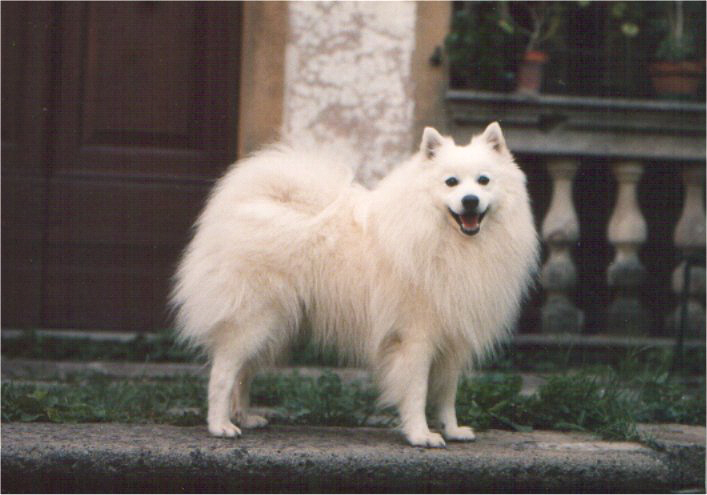 The skull looks in general less